
Godello: The Galician Grape Rescued to Rival White Burgundy
Godello went from near extinction in 1970s Valdeorras to Spain's most serious white. The rescue story, key producers, styles and how long to age it.

Fifty years ago, Godello wine barely existed. The grape survived in scattered rows among vines nobody valued, in a corner of Galicia better known for slate mines than cellars. Today critics compare top Godello to white Burgundy, and bottles from Valdeorras sit on serious restaurant lists from Madrid to London. This guide covers the rescue that saved the variety, where it grows, the two styles you will meet on shelves, the producers worth knowing, and how long to keep a good bottle.
The grape that nearly disappeared
Godello's low point has a precise cause. After phylloxera reached Valdeorras in 1882, growers replanted with high-yielding Palomino and Garnacha Tintorera, varieties suited to the bulk wine trade that dominated the valley for decades. By the early 1970s the region's traditional grapes had been pushed to the margins, farming paid poorly, and younger workers were leaving for the slate quarries.
The turnaround came from an unglamorous source: the local Agricultural Extension office. According to The Wines of Galicia, its director Horacio Fernández Presa surveyed growers in 1974 about which variety deserved a future, and Godello won clearly. The resulting programme, called ReViVal (short for "Restructuring the Vineyards of Valdeorras"), planted new Godello vines in 1975 and 1976 and brought in a first harvest of roughly 4,000 kilos. Over the following decades the old bulk varieties were steadily replaced, and the momentum has never really stopped: Godello plantings in Valdeorras doubled from 306 hectares in 2012 to 616 in 2022, and the region marked the programme's fiftieth anniversary in 2024.
Where Godello grows
Valdeorras remains the heartland. The D.O. sits inland, along the river Sil in eastern Galicia, where slate and granite soils and a climate that blends Atlantic freshness with continental warmth give Godello both ripeness and tension. It is the benchmark region, the one Jancis Robinson had in mind when she wrote about Valdeorras Godello as a Galician answer to burgundy.
Three neighbours matter too. Bierzo, just across the border in Castilla y León, grows old-vine Godello alongside its famous reds; our Bierzo region guide covers the terrain in detail. Monterrei, on the Portuguese border, is the warmest of the Galician zones and gives rounder, riper examples. Ribeira Sacra grows Godello on its vertiginous terraces, often blended with other local whites. In all four regions the red partner is usually Mencía, a grape with its own comeback story, which we cover in our Mencía grape guide.
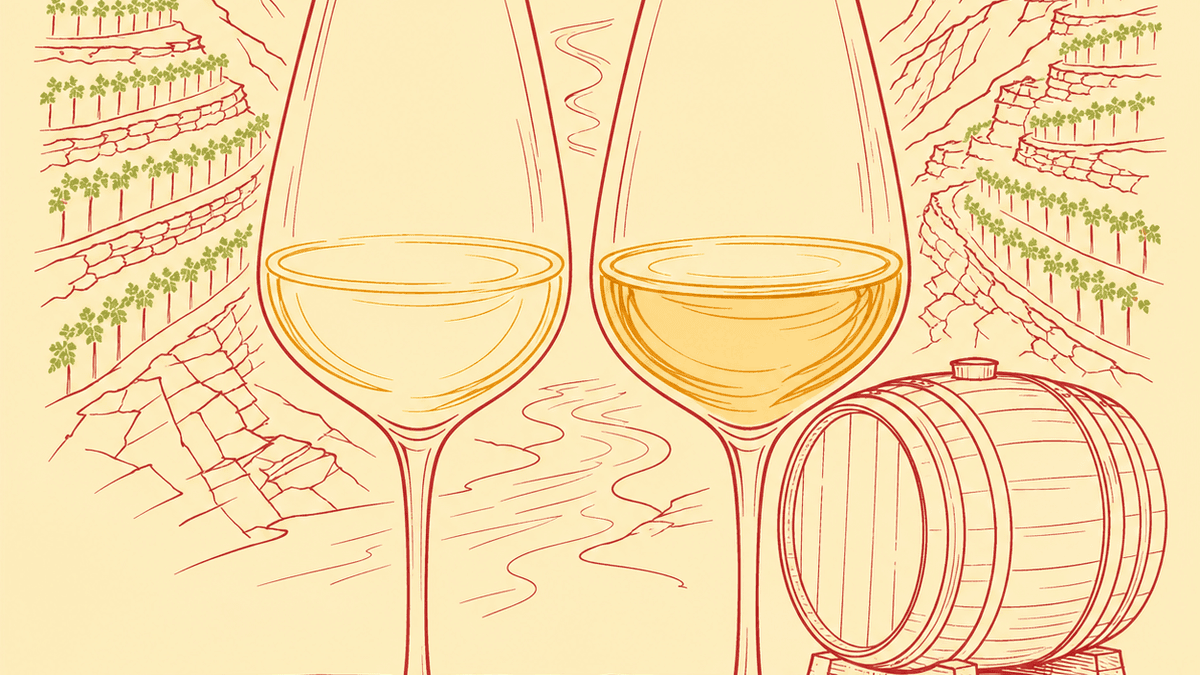 One grape, two styles: steel-fresh Godello and the richer, barrel-fermented expression.
If you start buying Godello seriously, the ageing question gets practical fast, because the answer changes by producer and cuvée. WineNest tracks a drinking window for each bottle in your cellar, per producer and vintage, so a Louro you should open this summer never gets confused with an As Sortes that wants five years. That matters more with Godello than with most Spanish whites, precisely because the good ones improve.
Two styles: steel or lees and barrel
Entry-level Godello is fermented in stainless steel and bottled young. Expect green apple, citrus, a little fennel and a wet-stone character, with more mid-palate weight than most young Spanish whites. This is the style that made the grape's reputation as a food wine: it handles everything from grilled fish to roast chicken.
The serious style is different. Producers ferment in large used oak, often 500-litre barrels, and leave the wine on its fine lees for months. The result is textural rather than oaky: yellow apple, stone fruit, hazelnut, a flinty finish. This is where the white Burgundy comparison comes from, and structurally the parallel with Chardonnay holds, since Godello relies on texture and balance rather than loud aromatics.
Producers and bottles to look for
Rafael Palacios is the name that lifted Godello into fine-wine territory. His Louro do Bolo, around 20 € in Europe and roughly $32 in the US for the 2024 vintage, is the best-value introduction to the lees-aged style. As Sortes, from old parcels in the Val do Bibei fermented and aged in used 500-litre oak, runs to about $79 and is the bottle most often set against premier cru white Burgundy in blind tastings.
Valdesil carries the deepest history: the Prada family's ancestor planted small Godello parcels, or pezas, in 1885, and the estate's Pedrouzos plot is considered the oldest Godello vineyard in Galicia. Montenovo is the affordable entry point; Valdesil Sobre Lías shows what lees ageing without oak can do.
Godeval, founded in 1986 in the restored monastery of Xagoaza near O Barco, was the first winery dedicated to varietal Godello and the first to export it. Its Viña Godeval remains a textbook steel-fresh example for under 20 €, and it made Wine Spectator's Top 100 back in 2011.
Beyond Valdeorras, Raúl Pérez's Ultreia bottlings from old vines in Valtuille de Abajo show how far Bierzo Godello can go, with spontaneous fermentation and long lees ageing producing savoury, structured whites. In Monterrei, Quinta da Muradella is the region's critical benchmark, with top bottlings scoring in the mid-90s from Parker's team.
How Godello differs from Albariño
The two Galician whites get confused constantly, and they could hardly be more different in intent. Albariño, from the coastal Rías Baixas, leads with aromatics: citrus blossom, peach, a saline snap, high acidity. Godello, from the warmer inland valleys, leads with texture: fuller body, quieter nose, more mid-palate weight and a mineral rather than maritime finish. Albariño is mostly a wine to drink young and cold; Godello, especially the lees-and-barrel versions, is built to develop. If the coastal style is more your thing, our guide to Albariño producers in Rías Baixas has you covered.
Should you age Godello?
Steel-fermented, entry-level bottles are best within one to three years of the vintage, while the fruit and tension are intact. The serious lees-aged and barrel-fermented cuvées reward patience: three to eight years from the vintage is a sensible window for wines like As Sortes or Ultreia La Claudina, during which the nutty, honeyed side develops without losing freshness. Well-stored top examples can go past ten, though that is the exception rather than the plan. If you are new to thinking about wine this way, start with our beginner's guide to drinking windows.
Frequently Asked Questions
What does Godello wine taste like?
Young Godello shows green apple, citrus and fennel with a stony, dry finish and noticeable body. Barrel-fermented versions add yellow apple, hazelnut and a creamy texture while staying dry and fresh.
Is Godello similar to Chardonnay?
Structurally, yes. Both are moderately aromatic grapes that express site and winemaking through texture, which is why lees-aged Godello is so often compared with white Burgundy. Flavours differ: Godello keeps a distinctly Atlantic, mineral edge.
Is Godello expensive?
Not at the entry level. Solid varietal Godello from Valdeorras starts under 15 €, quality lees-aged bottles sit around 20 € to 30 €, and only the top single-parcel wines reach 70 € and beyond.
Godello rewards exactly the kind of buying that benefits from a system: a few entry bottles to drink now, a few serious ones to forget about for five years. A cellar log with per-bottle drinking windows keeps both organised, so nothing gets opened a vintage too early or found a decade too late. Download WineNest and give your Godello the patience it was rescued for.