
Jumilla Wine Guide: Ungrafted Monastrell and Spain's Best-Value Serious Reds
Jumilla's sandy soils hide ungrafted pre-phylloxera Monastrell. Producers, the 2024-2025 drought harvests, prices from 8 EUR to icon, and what to cellar.

Jumilla is the rare wine region where a 12 € bottle and a serious collector's wine can come from the same hillside. Straddling Murcia and Albacete in Spain's arid southeast, this D.O. still farms ungrafted, pre-phylloxera-style Monastrell in pockets of pure sand, at altitudes that keep the wines fresher than the latitude suggests. It is arguably Spain's best value-to-seriousness ratio right now, and climate pressure is rewriting its story in real time. Here is how to buy, cellar and drink it.
Sand, limestone and vines on their own roots
When phylloxera devastated Europe in the late nineteenth century, almost every vineyard on the continent was replanted on American rootstock. Jumilla largely escaped. The louse cannot survive in loose sand, and the region's pockets of deep, sandy soil over limestone acted as a natural firewall; phylloxera did not seriously bite here until the late 1980s, a century after it emptied Bordeaux. The result is one of Europe's most remarkable viticultural relics: plots of Monastrell still growing pie franco, on their own roots, planted as head-trained bush vines that survive on roughly 300 mm of rain a year.
The official Jumilla D.O.P. council covers one municipality in Murcia and six in southeast Albacete, with vineyards mostly between 400 and 900 metres. That altitude matters. Days are ferociously hot, but nights at 700 or 800 metres drop sharply, preserving acidity and aroma in a grape that would turn jammy on a warm valley floor. If you have read about the old-vine Garnacha movement, the pattern will feel familiar: forgotten bush vines, low yields, co-operative-era prices, and a generation of growers who realised what they were sitting on.
Monastrell, the grape that shrugs at drought
Monastrell is the same variety the French call Mourvèdre, but Jumilla's version is its own animal. Expect a deep, dark wine built on ripe black fruit, wild herbs (the local scrubland of rosemary and thyme genuinely seems to echo in the glass), liquorice and a firm, dusty tannic grip. Alcohol is naturally generous, often 14 to 15 per cent, which is why the altitude-driven freshness of the best sites is so important.
The variety's superpower is resilience. Thick skins, late ripening and a bush-vine habit that shades its own fruit make Monastrell one of the Mediterranean's most drought-tolerant grapes, a fact the Wine & Spirit Education Trust highlighted in a 2026 profile of the region. As other regions scramble to adapt to a hotter Spain, Jumilla has been dry-farming this grape without irrigation for centuries.
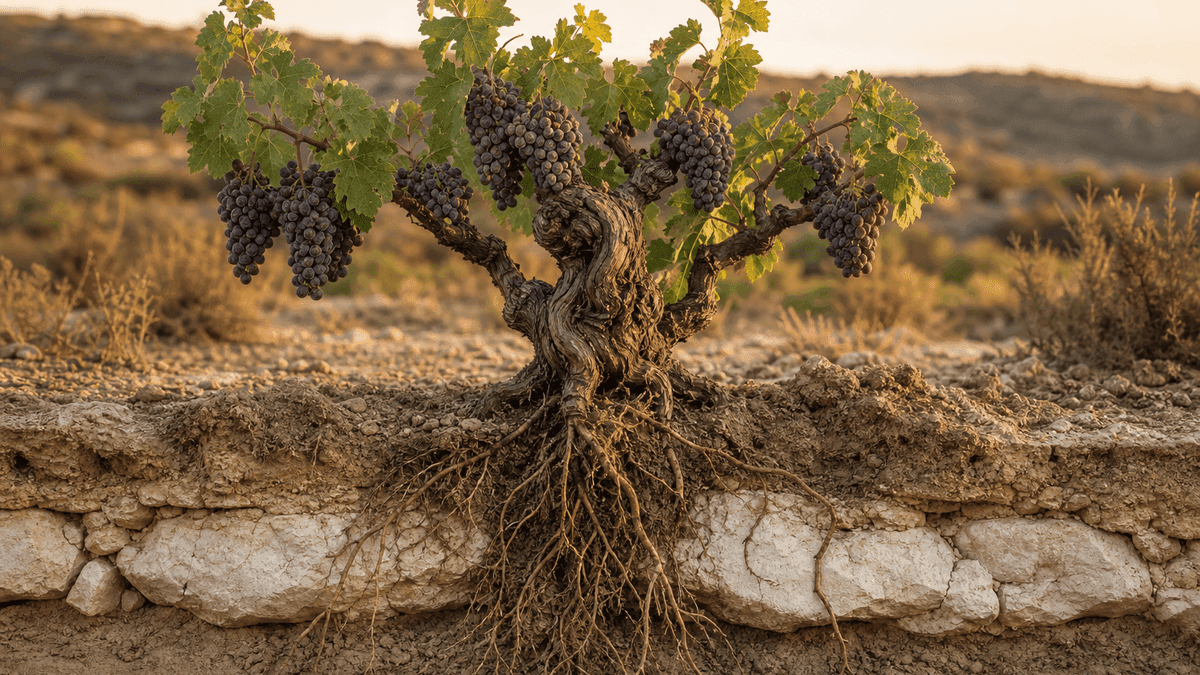 Loose sandy soil kept phylloxera out, so old Monastrell still grows on its own roots.
Drought, heat and the 2024–2025 harvests
Resilient does not mean invulnerable. After three consecutive years of severe drought, Jumilla confirmed its smallest harvest on record in 2024: around 46 million kilograms of grapes, with dry-farmed Monastrell hit hardest precisely because it receives no irrigation. Growers described vineyards on the brink, and some producers reported production down by half.
Then 2025 offered a reprieve. Rain finally arrived in March, bud burst was balanced, and despite spring hail and summer heat waves the regulatory board classified the 2025 vintage as "very good", with the crop recovering to roughly 49 million kilograms. The whiplash between those two vintages is the new normal here. Larger players are already adapting: Gil Family Estates has been trialling hybrid varieties and AI-driven optical sorting to protect quality through erratic seasons. For buyers, the practical takeaway is simple: vintage variation in Jumilla now matters in a way it did not a decade ago, and the surviving old-vine wines will only get scarcer.
The producers that changed the story
Two families did most of the heavy lifting in turning Jumilla from bulk-wine country into a region critics take seriously.
Casa Castillo is the reference estate. On the slopes of the Sierra del Molar, José María Vicente farms organically and makes a range that reads like a masterclass in terroir: an estate Monastrell of absurd value, the stony Las Gravas, and at the top Pie Franco, from a single sandy parcel of ungrafted Monastrell planted in 1942. Fermented with a generous portion of whole clusters and trodden by foot, it is routinely counted among Spain's great reds, and quantities shrink with nearly every vintage.
Juan Gil, founded in 1916 and now run by the family's fourth generation, built the commercial ladder that carried Jumilla into wine shops worldwide, from the juicy entry-level bottlings up through the oak-polished Silver and Blue labels. In 2001 the family created Bodegas El Nido with Australian winemaker Chris Ringland, blending 75-to-95-year-old dry-farmed Monastrell with Cabernet Sauvignon from vineyards at 700 to 850 metres. El Nido and its sibling Clio became the region's cult wines and proved Jumilla could command icon prices.
The newest chapter belongs to Bodega Cerrón, in the high Albacete village of Fuente-Álamo. The fourth generation of the Cerdán family farms around 30 hectares biodynamically at 840 to 940 metres, much of it ungrafted, under the Stratum Wines label; Jamie Goode has called the results remarkable. Their wines, such as Matas Altas, show a lighter-framed, mineral, low-intervention side of Monastrell that would have been unthinkable in Jumilla twenty years ago.
The price ladder, from 8 € to icon
Few regions let you climb from weeknight bottle to collector's wine so cheaply. A rough map:
- Around 8–12 €: Honoro Vera, Juan Gil 4 Meses, co-operative old-vine bottlings. Honest, ripe, herb-tinged Monastrell for the table.
- 12–20 €: Juan Gil 12 Meses (Silver Label), Casa Castillo's estate Monastrell, Cerrón's village wines. This is the sweet spot where Jumilla embarrasses regions charging twice as much; if you are building a starter cellar on 500 €, this tier belongs in it.
- 25–45 €: Casa Castillo Las Gravas, Clio, Stratum single-vineyard wines. Genuine fine wine with site character.
- 60 € and up: Casa Castillo Pie Franco and El Nido. Scarce, ageworthy, and increasingly chased by collectors.
What to cellar and what to drink now
Entry-level Jumilla is made for the short term: drink within two to four years of the vintage while the fruit is loud. Mid-tier wines like Las Gravas or the Silver Label reward five to ten years. Pie Franco and El Nido are proper cellar wines; strong vintages can develop over fifteen years or more, trading black fruit for leather, dried herbs and earth. Given how differently a drought year like 2024 and a recovery year like 2025 will evolve, it pays to think in drinking windows rather than fixed rules.
This is exactly where a cellar app earns its keep. WineNest groups your bottles by region and tracks a drinking window for each vintage, so a vertical of Pie Franco or a mixed case of Juan Gil labels stays organised instead of becoming a guessing game at the rack. It will nudge you towards the 2020 before it fades while the 2025 sleeps on.
Food: it loves the grill
Monastrell's ripe fruit and grippy tannin were made for fire. In Murcia it is poured alongside arroz con conejo (rabbit rice cooked over vine cuttings), grilled lamb chops and michirones, the local broad-bean stew. At home, think anything charred: butterflied leg of lamb, smoked brisket, grilled aubergine with miso, even a burger. The wine's herbal edge also flatters hard sheep's cheeses. What it does not want is delicate food; save it for dishes with smoke and fat.
FAQ
Is Jumilla wine always powerful and high in alcohol? Mostly, yes: 14 to 15 per cent is normal. But high-altitude and low-intervention producers such as Cerrón are proving Monastrell can also be mid-weight and fresh, so read the label and the elevation.
Is Monastrell the same as Mourvèdre? Yes, genetically identical to the Mourvèdre of Bandol and the southern Rhône. Jumilla's dry, high, continental conditions simply produce a riper, more rustic expression than coastal Provence.
Which recent vintages should I look for? The drought-shrunk 2024 produced tiny volumes of concentrated wine, while 2025 was officially rated very good and is fresher and more classical. Both are worth buying; just expect different evolution curves.
If Jumilla has a lesson, it is that seriousness and price are not the same thing. Buy a ladder of it, from an 8 € weeknight bottle to one ungrafted icon, and let the vintage-by-vintage drinking windows tell you when each rung is ready. Download WineNest and give your Monastrell the patience it was farmed with.