
Tapas night, six dishes, six bottles
Six classic Spanish tapas, six specific bottles to pair them with. A shopping list for a real Friday night, with current vintages and one alternative per dish.

Most tapas guides tell you to "open a bottle of table wine and enjoy." That is fine advice, and it is also why so many tapas nights taste flat by plate four. A spread of six dishes is six different flavours and six different textures, and asking one bottle to cover all of it is asking too much. The point of this piece is the opposite: one specific wine per plate, producer named, current vintage flagged. By the time you finish reading you should be able to walk into the shop with a list of six bottles and walk out ready to host.
Jamón ibérico de bellota: Manzanilla En Rama
A good acorn-fed jamón is the easiest dish to ruin with the wrong wine. The fat is sweet, the salt is sharp, and any red with serious tannin turns the whole thing metallic. The traditional answer, and still the right one, is a chilled glass of Manzanilla from Sanlúcar de Barrameda. The salty tang of the wine meets the salt of the ham, the wine's bone-dry finish cuts the fat, and you reach for the next slice almost involuntarily. Decanter's sherry-and-tapas guide has been making this case for years and they are not wrong.
The bottle: Bodegas Hidalgo La Gitana Manzanilla En Rama, non-vintage, bottled in spring saca. Look for the most recent saca date on the back label. Around 18 € in Spain.
Alternative: Tío Pepe Fino En Rama from Gonzalez Byass, the spring saca. Slightly broader, slightly less saline, equally clean.
Gambas al ajillo: Albariño from Rías Baixas
Garlic prawns in olive oil need a white with real acidity to cut the oil and enough aromatic lift to keep up with the garlic. Verdejo can do this. Godello can. But the classic, and still the best, is Albariño from the Val do Salnés. The grape was made for shellfish, the way Riesling was made for trout. Look for a bottling with some texture, not the thinnest, cheapest example on the shelf.
The bottle: Pazo Señorans Albariño 2024, Rías Baixas D.O. A benchmark. Jasmine, lime, a faint natural spritz, and the kind of saline finish that makes you want a second prawn before you have finished the first. Around 17 € in Spain.
Alternative: Do Ferreiro Cepas Vellas, current release 2023 or 2024. Pricier (around 35 €), sourced from a 1.5-hectare plot planted in 1785, and arguably the apex of the grape. Worth it if the meal is for someone you want to impress.
Pimientos de Padrón: Ameztoi Rubentis
Padrón peppers are blistered in hot oil, salted heavily, and served with the promise that roughly one in ten will be properly spicy. The wine needs to handle the green vegetal note, the heat, and the salt all at once. Txakoli is the regional answer from the Basque coast. The Rubentis is a rosado made from a 50/50 field blend of Hondarrabi Beltza and Hondarrabi Zuri, which gives you red-fruit lift over green-apple acidity. It is the kind of bottle that makes you wonder why you ever drank anything else with peppers.
The bottle: Ameztoi Rubentis Rosado 2024, Getariako Txakolina D.O. Strawberry, lime zest, and a clean, very dry finish. Around 19 € in Spain.
Alternative: A dry Verdejo from Rueda such as Telmo Rodríguez Basa, 2024. Less interesting, but it covers the same job for half the money.
Croquetas: Recaredo Terrers Brut Nature
Anything fried sits in your mouth like a small warm pillow of fat, and the wine has to puncture it. Sparkling does this better than still wine, and traditional-method sparkling from Penedès does it better than most. Recaredo only makes brut nature, which means no sugar added at disgorgement, which means the wine is dry enough to slice through a croqueta de jamón without sweetening the finish. The bubbles do the rest.
The bottle: Recaredo Terrers Brut Nature Gran Reserva, Corpinnat. Most current releases are from the 2018 or 2019 base, with sixty months on the lees. Around 25 € in Spain.
Alternative: Gramona Imperial Gran Reserva, 2018 base, disgorged 2023. Slightly broader and more brioche-driven, equally serious. Around 22 €.
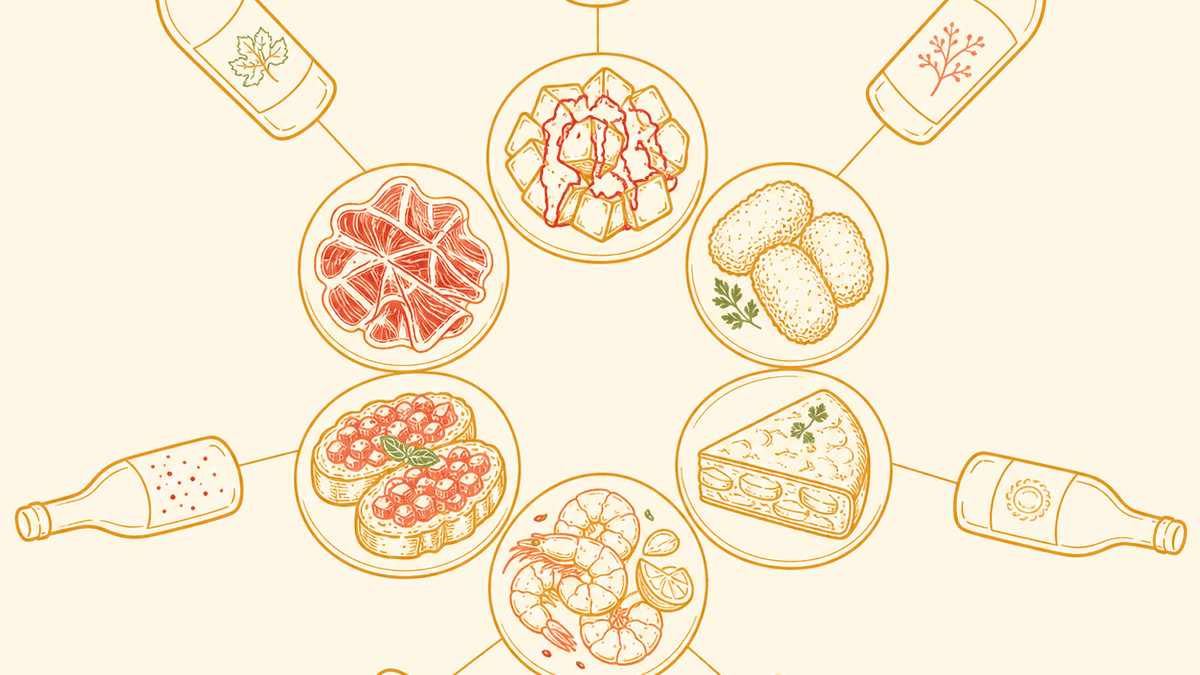 Six plates, six pours. The line from each dish points to its bottle.
A note on what makes this list practical
Six bottles sounds like a lot. It is not, once you remember that tapas night is about small pours, not full glasses. You are pouring roughly 60ml of each, six times, so a single bottle covers ten or twelve people across the night. The hard part is the cellar logistics. WineNest groups your bottles by region and food affinity, so when you are scrambling at 6:45pm to find the Manzanilla you bought last month, the app tells you it is on the second shelf with the other fortifieds, three slots from the Cava. That is the difference between hosting and re-hosting from the rack every twenty minutes.
Pulpo a la gallega: Ultreia Saint Jacques
Galician octopus, dressed with paprika and olive oil on a wooden board, is one of those dishes that looks rustic and is in fact extremely particular about its wine. White is the obvious choice, and a structured Albariño works. But the smoky paprika and the sweet, gelatinous octopus also reward a light, peppery red from the same coast. Mencía from Bierzo, made in the cool-climate style Raúl Pérez popularised, is the local move. Jancis Robinson has written that the Ultreia bottlings are beautiful with pulpo.
The bottle: Raúl Pérez Ultreia Saint Jacques, Bierzo D.O., current release 2023. Under 13% alcohol, fermented mostly with full clusters, aged in used barrel. Bright, lifted, no clumsy oak. Around 16 € in Spain.
Alternative: A more structured Albariño such as Forjas del Salnés Leirana, 2023. White instead of red, but covers the same role through sheer textural weight.
Manchego curado: Viña Tondonia Reserva
Aged Manchego is the only dish on this list where you actually want some tannin, because the cheese is rich enough to absorb it and the long ageing has built up enough savoury character to meet a serious red. The classic Spanish answer is aged Rioja, and the most classic of the classic is Viña Tondonia. The current Reserva is the 2013, aged in American oak from the producer's own cooperage. It is medium-bodied, not heavy, and it tastes of dried cherry, cedar, leather and a chalky finish that pulls the cheese fat down to where it belongs.
The bottle: R. López de Heredia Viña Tondonia Reserva 2013, Rioja D.O.Ca. 70% Tempranillo, 20% Garnacha, 10% Graciano and Mazuelo. Around 32 € in Spain. If you are curious where this bottle sits on its drinking window, the answer is comfortably inside it for the next decade.
Alternative: Bodegas Borsao Tres Picos Garnacha 2023, Campo de Borja D.O. Younger, plummier, more upfront. Around 15 € and a fine pairing for the cheese even if it is a different conversation.
Setting the order
The instinct is to open everything at once. Resist. Tapas night works best when the wines climb in roughly the order the bottles get heavier, with a return to sherry for the cheese.
A workable progression: Cava with the croquetas, Manzanilla with the jamón, Txakoli with the Padrón peppers, Albariño with the prawns, the Mencía with the pulpo, and Tondonia with the Manchego. That is sparkling, fortified, rosado, structured white, light red, structured red. Looping back to a small pour of Manzanilla with the cheese is a very Sanlúcar move and works.
If you only remember one rule: do not open the Tondonia first. It will make every wine that comes after taste thinner than it is.
Frequently Asked Questions
Can I really serve all six bottles with one group? Yes, with small-pour discipline. Tapas night is six 60ml pours per person across the evening, not six full glasses. A bottle is 750ml, so you have twelve generous pours per bottle. For a group of six, every bottle is shared twice and there is still some left over.
What if I only buy three bottles? Pick a Manzanilla, an Albariño and a Rioja Reserva. Those three cover about 80% of a tapas table: anything cured (sherry), anything from the sea or with garlic (Albariño), anything braised or paired with cheese (Reserva).
Does the order matter? Yes, more than people think. Heavier wines flatten lighter wines that follow them, so a sip of Tondonia followed by a sip of Albariño makes the Albariño taste hollow. Climb from sparkling to fortified to white to red, and end on the cheese course.
One more thing
If this is the sort of evening you want to repeat, the Mencía pairing logic also works for paella, and the how-to-read-a-Spanish-wine-label primer is what you want in your pocket for the shop. Otherwise, the list above is enough.
Download WineNest to keep your six-bottle inventory tidy, grouped by region and by which dishes they actually pair with. Tapas night should be a Friday lift, not a Friday spreadsheet.