
Txakoli Grows Up: A Guide to the Basque Coastal White in 2026
The three Txakoli D.O.s, the Hondarrabi Zuri grape, producers worth seeking, what to buy from the 2025 vintage and whether the Basque white can age.

Txakoli spent decades typecast. It was the wine of the pour: a bartender in San Sebastián holding the bottle a metre above a flat tumbler, the splash raising a brief fizz, the glass emptied in two swallows between bites of anchovy. That wine still exists, and it is still a joy. But the Basque Country's coastal white has quietly grown a second identity, one of lees ageing, single vineyards and bottles that hold their own next to fine Albariño. This guide covers both versions of Txakoli, and how to buy each in 2026.
Three denominations, one Atlantic white
Txakoli (Txakolina in Basque) comes from three small D.O.s strung across the Basque Country, all shaped by the damp, green climate of the Bay of Biscay. Rain is frequent, sunshine is rationed, and the wines carry that weather: low-ish alcohol, sharp acidity and a saline edge.
Getariako Txakolina
The oldest and best-known denomination, created in 1989 around the fishing town of Getaria, west of San Sebastián. Vines are trained high on pergolas to keep air moving through the canopy, often on slopes that look straight at the sea. It is also the largest of the three: according to figures released by the D.O. council in January 2026, plantings reached 479 hectares in 2025, spread across 31 bodegas. The classic Getaria style is the one most people picture: pale, bone dry, lightly spritzy, smelling of green apple and sea spray.
Bizkaiko Txakolina
The Bizkaia denomination, around Bilbao, dates from 1994. Vineyards are more scattered, and so are the styles. This is where much of the region's experimentation lives: skin contact, barrel fermentation, still (non-spritzy) whites and a small but genuine red tradition around the village of Bakio. Spanish Wine Lover's producer guide treats Bizkaia as the D.O. that has done the most to prove Txakoli can be a gastronomic white rather than a beach one.
Arabako Txakolina
The smallest and youngest of the three, recognised in 2001, tucked into the Ayala valley of Álava. It sits slightly inland, so the wines tend to be a touch riper and rounder while keeping the Atlantic nerve. Almost everything here revolves around a handful of growers, with Astobiza the name you are most likely to find abroad.
Hondarrabi Zuri, the grape doing the work
Nearly all white Txakoli is built on Hondarrabi Zuri, a variety that barely exists outside the Basque Country. On its own it gives modest alcohol, lemon and green-apple fruit, a leafy herbal note and acidity that stays vivid even in warm years. Supporting varieties fill out the blends: Hondarrabi Zuri Zerratia (the local name for Petit Courbu) adds flesh and perfume, especially in Bizkaia, while Izkiriota (Gros Manseng) appears in smaller doses. The red counterpart, Hondarrabi Beltza, goes into the region's pale rosés and its rare, peppery reds. If you enjoy the tension of coastal Spanish whites, the comparison with Rías Baixas is instructive; our guide to Rías Baixas Albariño producers makes a good companion read.
The high pour and the new wave
The escanciado, that theatrical pour from height, was borrowed from Basque cider houses. It is not just showmanship: breaking the wine against the side of a wide tumbler lifts the dissolved carbon dioxide, sharpens the aromatics and turns a simple young white into something bright and briefly foaming. For classic, just-bottled Txakoli drunk with pintxos, it genuinely works.
What has changed is everything around it. Producers now hold wines on their fine lees for months or years, bottle single vineyards and release cuvées with no spritz at all, aimed at the dinner table rather than the bar top. Decanter has charted this re-emergence in its Top 20 Txakoli selection, and the D.O. rules increasingly recognise aged categories alongside the young wines. Itsasmendi in Bizkaia was a pioneer of lees ageing here, and Astobiza's single-vineyard Malkoa in Álava has become the reference for age-worthy Txakoli. These bottles do not want the high pour. Treat them like any serious white: a proper glass, not too cold.
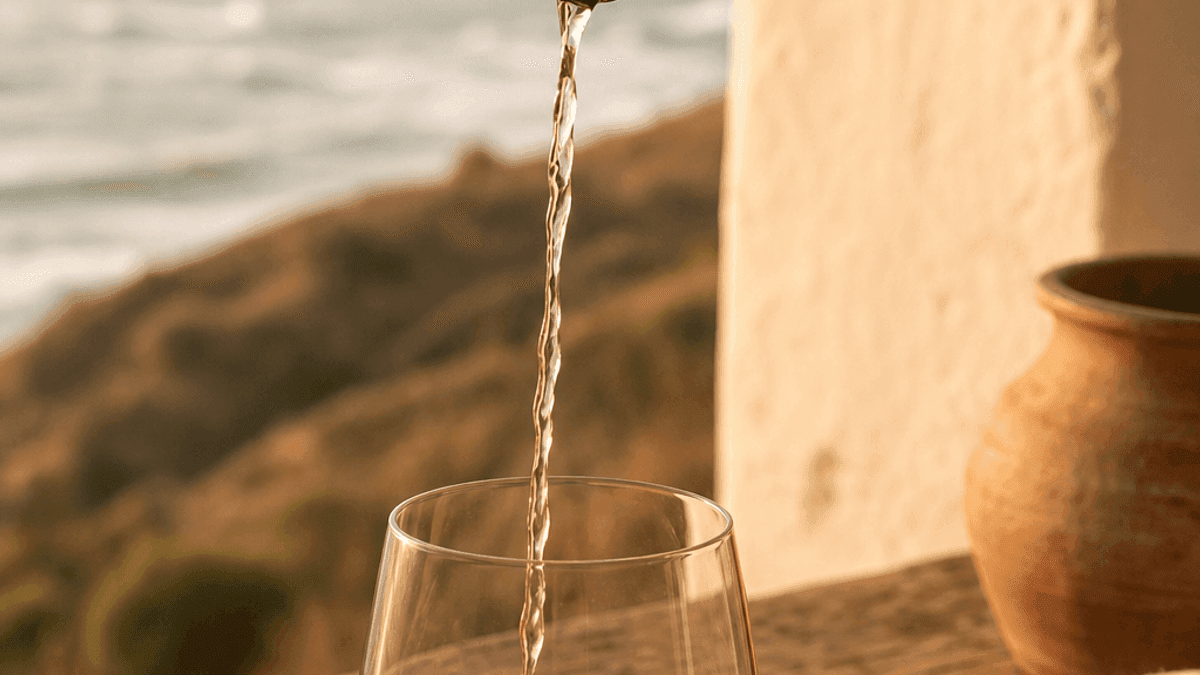 The escanciado lifts the dissolved carbon dioxide in young Txakoli; the new lees-aged cuvées skip it entirely.
With two styles in play, keeping track matters more than it used to. WineNest groups your bottles by region and grape, so your Getariako and Bizkaiko whites surface together with their drinking windows. That makes it easy to see which bottle is a drink-this-summer spritzer and which is a lees-aged keeper that can wait.
Producers worth seeking in 2026
- Txomin Etxaniz (Getariako). The historic house of Getaria, with family records in the village going back to 1649. Its young white is the benchmark of the classic style, and the TX cuvée shows what a little ageing adds.
- Ameztoi (Getariako). Txomin Etxaniz's neighbour on the same hillside, farming around 50 hectares. Its Rubentis, a pale spritzy rosé of Hondarrabi Zuri and Hondarrabi Beltza, has become a summer fixture on export markets.
- Rezabal (Getariako). A reliable source of taut, saline whites and one of the better-value rosés in the category.
- Doniene Gorrondona / DGTX (Bizkaiko). Based in Bakio and renamed DGTX in 2024, this bodega farms a rare parcel of pre-phylloxera Hondarrabi Beltza and makes the region's most admired red, alongside barrel-fermented whites; its importer De Maison Selections documents the estate's role in reviving Bizkaia's wine tradition from 1994 onwards.
- Itsasmendi (Bizkaiko). The lees-ageing pioneer. Itsasmendi 7 remains one of the most complete Txakolis made, and older vintages hold up well.
- Gorka Izagirre (Bizkaiko). Tied to the family behind the three-Michelin-star Azurmendi restaurant; its aged whites show how far Hondarrabi Zuri Zerratia can stretch.
- Astobiza (Arabako). The flagship of Álava, and its single-vineyard Malkoa is the strongest argument yet that Txakoli can age with grace.
What to buy in 2026
The wines reaching shelves now come from the 2025 harvest, the 36th of the Getariako denomination, presented in January 2026 at the Balenciaga Museum in Getaria. Production came in at roughly 2.5 million litres, around 3.3 million bottles, with the council describing quality as good and the profile as fruity with marked acidity, according to Vinetur. About 90% of it is white and most of the rest rosé.
Practical advice: buy 2025 whites and rosés freely and drink them within a year or two of release, while the fizz and the fruit are at their peak. For the serious styles, current releases of lees-aged and single-vineyard cuvées usually carry vintages from 2021 to 2023, and those are the ones to consider laying down. Classic young Txakoli remains one of Spain's better bargains, typically under £18 in the UK, with the top cuvées rarely crossing £35.
At the table
Txakoli's pairing brief is short and happy: if it came out of the sea, it works. Grilled turbot and hake in the Getaria style, anchovies, oysters, fried squid and, above all, the gilda, that skewer of anchovy, olive and pickled pepper whose salt and vinegar would flatten most whites. The wine's acidity resets the palate; its salinity echoes the food. Lees-aged versions can go further, standing up to richer fish in sauce or aged sheep's cheese. If you are building a Basque-leaning spread at home, our tapas night pairing guide covers the wider table, and our piece on reading a Spanish wine label will help you decode the back label of any Txakoli you pick up.
Frequently Asked Questions
Is Txakoli always fizzy?
No. The light spritz comes from bottling young with a little dissolved carbon dioxide, and it defines the classic Getaria style. Lees-aged and single-vineyard bottlings are usually still wines, and the difference is deliberate. If the label mentions lees ageing or a named vineyard, expect a still white.
Should I pour Txakoli from a height at home?
Only for the young, spritzy style, and even then it is optional. The high pour aerates the wine and lifts the fizz, which flatters a just-released bottle. Aged cuvées lose more than they gain from it; serve those in a normal white-wine glass at around 10 to 12 degrees.
Can Txakoli age?
The classic style cannot and is not meant to: drink it within two years. But the new wave changes the answer. Lees-aged bottlings drink well at three to five years, and single-vineyard wines such as Astobiza's Malkoa or Itsasmendi 7 have shown they can develop for longer, gaining honeyed and smoky depth while keeping their acidity.
How do you pronounce Txakoli?
Roughly cha-ko-LEE. The Basque spelling Txakolina appears on labels within the D.O. names, and you will also see the Spanish form chacolí. All refer to the same wine.
Txakoli is now two wines in one region, and that is precisely what makes it worth following: a bottle for the beach and a bottle for the cellar, often from the same producer. Drinking-window tracking keeps the two apart for you, flagging the young spritzy bottles to open this summer while your lees-aged keepers rest untouched. Download WineNest and give your Basque whites the shelf life they deserve.