
Cava Guide: How Spain's Sparkling Wine Got Serious
Cava grew up while nobody was looking: the Corpinnat breakaway, the new Guarda Superior tiers, why Xarel·lo is the ageing grape, and bottles for every budget.

For decades, Cava was the sparkling wine you bought without thinking: reliably dry, reliably cheap, and gone before anyone asked what was in the glass. That reputation is now badly out of date. While most drinkers were looking elsewhere, Cava went through a breakaway movement, a full rewrite of its rule book and a quiet ageing revolution. Today the region offers some of the best-value traditional-method fizz anywhere. This guide covers what changed, what the new labels actually mean, and which bottles deserve your money.
The breakaway that forced the issue
The first crack appeared in 2012, when Raventós i Blanc, whose family has grown vines in Penedès since 1497 and effectively invented Cava in 1872, walked out of the D.O. to champion its own tiny appellation-in-waiting, Conca del Riu Anoia. The complaint was simple: a denomination that allows grapes from almost anywhere in Spain, at industrial yields, says nothing about where a wine comes from.
The bigger rupture came in 2019, when Corpinnat, a private brand founded the year before, left the D.O. after negotiations to coexist within it collapsed. Its founders included the producers most critics considered the region's best: Gramona, Recaredo, Llopart, Torelló, Nadal and Sabaté i Coca. Corpinnat's rules go far beyond the official ones. Grapes must be 100% organic, hand-harvested, grown within a defined heart of Penedès and bought at minimum guaranteed prices; wines must be vinified entirely at the winery and aged at least 18 months, with each house releasing cuvées past 30 months.
The movement kept growing while the D.O. modernised, and in April 2026 it landed its biggest catch yet: Juvé & Camps left the D.O. to become Corpinnat's largest member, bringing roughly 2.5 million bottles to a collective of 22 wineries that sold about 3 million in 2025. A dissident club of artisans has become a parallel appellation in all but name. It is the most interesting quality story in Spanish wine since Priorat's rebirth thirty years ago.
The D.O. fought back with real rules
Losing your best producers concentrates the mind. From 2021 the D.O. Cava rolled out a reform that finally separates everyday fizz from serious wine, and the new terms now appear on every label.
Cava de Guarda is the base tier: a minimum of nine months on the lees, your reliable aperitif style. Cava de Guarda Superior is where the reform bites. It splits into Reserva (at least 18 months on the lees), Gran Reserva (at least 30 months) and Paraje Calificado (at least 36 months, from a single named site). Guarda Superior wines must come from vineyards over ten years old, hand-harvested, with yields capped at 48 hl/ha and the vintage stated on the label. Since the 2025 harvest, all Guarda Superior fruit must also be certified organic, a requirement no other major sparkling region imposes at this scale. Paraje Calificado remains genuinely rare: only around fifteen wines qualify. If you enjoy decoding Spanish bottles, the same logic applies across the country, and our guide to reading a Spanish wine label covers the rest.
For context, 30 months is the lees-ageing minimum for vintage Champagne. A Cava Gran Reserva meeting that bar routinely costs 15 € to 25 €, a third of the price of most grower Champagne.
Three grapes, one backbone
Classic Cava is a blend of three local white grapes. Macabeo brings fruit and softness, Parellada brings delicacy and floral lift from higher vineyards, and Xarel·lo provides the spine: acidity, structure and an unusual talent for ageing.
That talent has a measurable basis. Research in the late 1990s showed Xarel·lo has the highest concentration of resveratrol, a natural antioxidant, of any white grape studied, which helps its wines resist oxidation through very long lees ageing. This is why the region's most ambitious cuvées often contain 70% Xarel·lo or more, and why top producers favour Brut Nature, with no sugar dosage added at disgorgement: the wine holds up on its own. If you remember one grape name from this guide, make it this one.
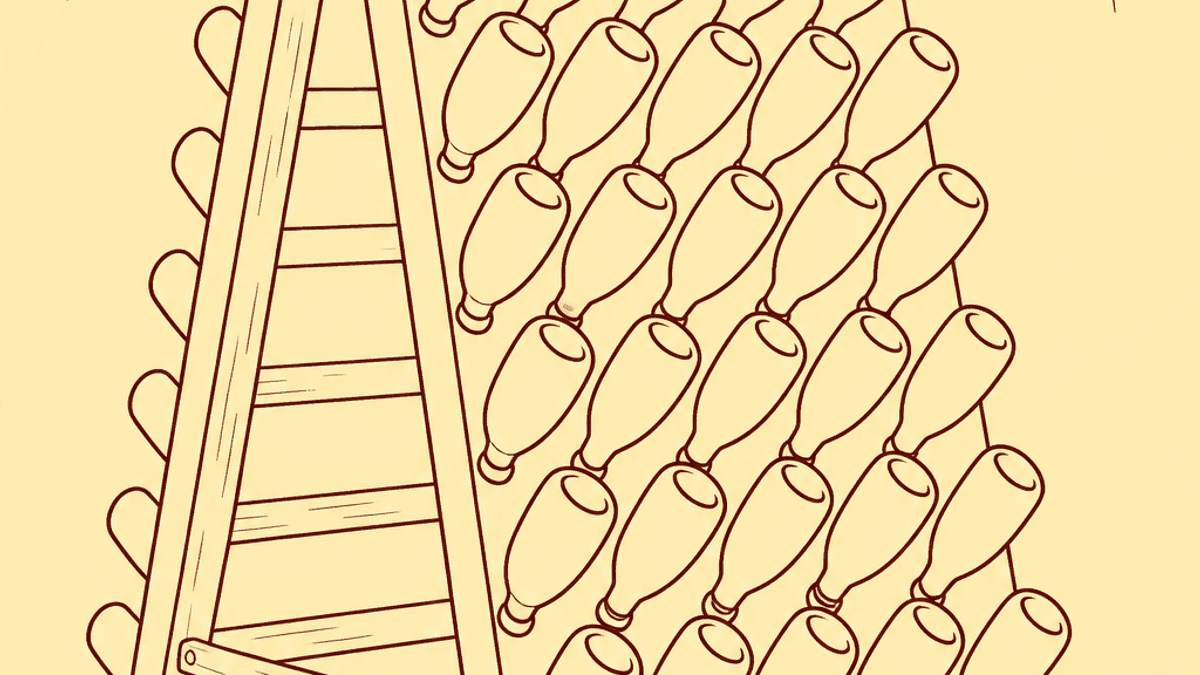 Long lees ageing in underground cellars is what separates the new wave of Cava and Corpinnat from the supermarket bottle.
Sparkling wine is also the category most likely to get lost at home, shoved to the back of the fridge or forgotten in a cupboard since New Year's Eve. WineNest keeps your sparkling stock visible alongside the rest of your bottles and tracks each one's drinking window, so a disgorgement date on the back label becomes a reminder rather than a mystery.
What to buy at every price
Names matter more than ever, because the best producers now sit both inside and outside the D.O. A short list worth memorising, all widely available:
- Around 10 € to 13 €: Agustí Torelló Mata Brut Reserva (D.O. Cava). Honest, appley, 18-plus months of ageing for the price of a takeaway.
- Around 15 € to 20 €: Agustí Torelló Mata Gran Reserva (D.O. Cava), a 30-month wine at a startling price; Llopart Brut Reserva (Corpinnat) for a step up in texture.
- Around 20 € to 30 €: Gramona Imperial (Corpinnat), the classic gateway to long-aged style; Recaredo Terrers (Corpinnat), biodynamic, Brut Nature, bone-dry and saline; Raventós i Blanc Blanc de Blancs (Conca del Riu Anoia), chalky and precise.
- Special occasion: Mestres Mas Vía (D.O. Cava), aged the best part of a decade; Recaredo Reserva Particular; Gramona Enoteca, which spends over ten years on the lees and costs around 155 €, territory where equivalent Champagne starts at several hundred.
Serving it, pairing it, and whether to keep it
Serve young Cava de Guarda well chilled at 6 to 8 °C. Long-aged bottles deserve gentler treatment: 8 to 10 °C and a white-wine glass rather than a flute, which lets the toasted, honeyed aromas open up.
At the table, Cava is far more than an aperitif. The acidity and bubbles cut through fried food, so croquetas, calamares and patatas bravas are natural partners; a Gran Reserva has the depth for roast chicken, arròs negre or aged Manchego. It may be the single most versatile wine for a tapas night spread across several dishes.
Should you age Cava at home? Mostly no. Unlike still wine, traditional-method sparkling does most of its maturing on the lees before disgorgement, and producers release it when they consider it ready. Buy your age rather than build it: choose a Gran Reserva instead of cellaring a Reserva. The exceptions are top Brut Nature bottlings from the likes of Recaredo and Gramona, which can gain complexity for three to five years after disgorgement if stored cool and dark. If the back label carries a disgorgement date, that is your clock.
Frequently asked questions
Is Corpinnat still Cava?
Legally, no. Corpinnat wines left the D.O. in 2019, so the word Cava cannot appear on their labels. In practice they are made in the same villages, from the same grapes, by the same method, under stricter rules. Think of them as estate-grown Penedès sparkling wine.
What does Brut Nature mean?
No sugar added at disgorgement (less than 3 g/l residual). It is the driest style and a Cava speciality, made possible by ripe fruit and Xarel·lo's resistance to oxidation. Expect a leaner, more mineral profile than Brut.
How long does an open bottle last?
With a proper sparkling-wine stopper in the fridge, a young Cava stays lively for one to two days; fuller Gran Reservas can survive a third. The spoon-in-the-neck trick does nothing.
Cava finally rewards the drinker who pays attention, and the gap between a 9-month supermarket bottle and a 30-month Gran Reserva has never been easier to taste or cheaper to explore. Log a couple of bottles from each tier, note the disgorgement dates, and the drinking-window tracker will tell you which one to open next and which one improves with a little patience. Download WineNest and give your sparkling wines the shelf space they have earned.