
How to Protect Wine from Summer Heat (Before August Ruins It)
Heat, not cold, kills wine. The science of heat damage, real temperature thresholds, a room-by-room audit of your home, and how to spot a cooked bottle.


Your wine probably survives winter without a scratch. It is July and August that quietly ruin it. Learning to protect wine from summer heat matters more than any cellar gadget you will buy, because a bottle that spent a decade resting perfectly can be undone by a single hot fortnight in a closed flat. The damage is chemical, it is usually invisible until you pull the cork, and it is almost entirely preventable once you understand what heat actually does to the liquid inside the glass.
What heat does to a bottle
Wine ages through slow chemical reactions, and those reactions speed up as it gets warmer. A rough rule borrowed from chemistry says reaction rates roughly double for every 10 °C rise in temperature. Work summarised by the Australian Wine Research Institute and modelled in later studies suggests a bottle kept at 23 °C ages somewhere between two and eight times faster than the same bottle at 13 °C. Three warm years can therefore cost you a decade or more of graceful development.
Push past gentle warmth and the change stops being "faster ageing" and becomes damage. The same review notes faulty flavours and falling quality after twelve months at 30 °C, and visible, tasteable changes within a matter of days above 40 °C. The general guidance is blunt: anywhere that sits above 25 °C for long stretches, or spikes past 40 °C even briefly, can harm the wine. A 2015 study in the Australian Journal of Grape and Wine Research found that elevated storage temperature does not simply fast-forward normal ageing; it shifts the chemistry down different paths entirely, which is why heat-hit wine tastes stewed and flat rather than pleasantly mature.
Then there is physics. As wine warms it expands, and inside a sealed bottle that expansion has nowhere to go except against the cork. Repeated warming pushes the cork outward and can force liquid past it, leaving the sticky seepage down the neck that any experienced buyer treats as a warning sign.
Why the swing is worse than the warmth
A steady 20 °C is not ideal, but wine copes with it. What really punishes a bottle is the daily cycle: hot afternoons, cooler nights, repeated for weeks. Each swing expands and contracts the wine, working the cork loose and drawing tiny amounts of air in past a seal that should stay shut. Stable and slightly-too-warm beats cool-but-lurching almost every time, which is why an attic or a sun-facing shelf is more dangerous than its average temperature suggests.
This is where the Spanish summer earns its reputation. AEMET confirmed that the summer of 2025 was the country's hottest on record, with an August heatwave it called the most intense ever measured. Now picture the classic August scenario: a flat shut up for a month while the family is at the coast, blinds down, no ventilation, indoor temperatures parked above 30 °C day after day. Nobody is home to notice, and the wine bakes through the worst fortnight of the year. That closed-flat month does more harm than the other eleven combined.
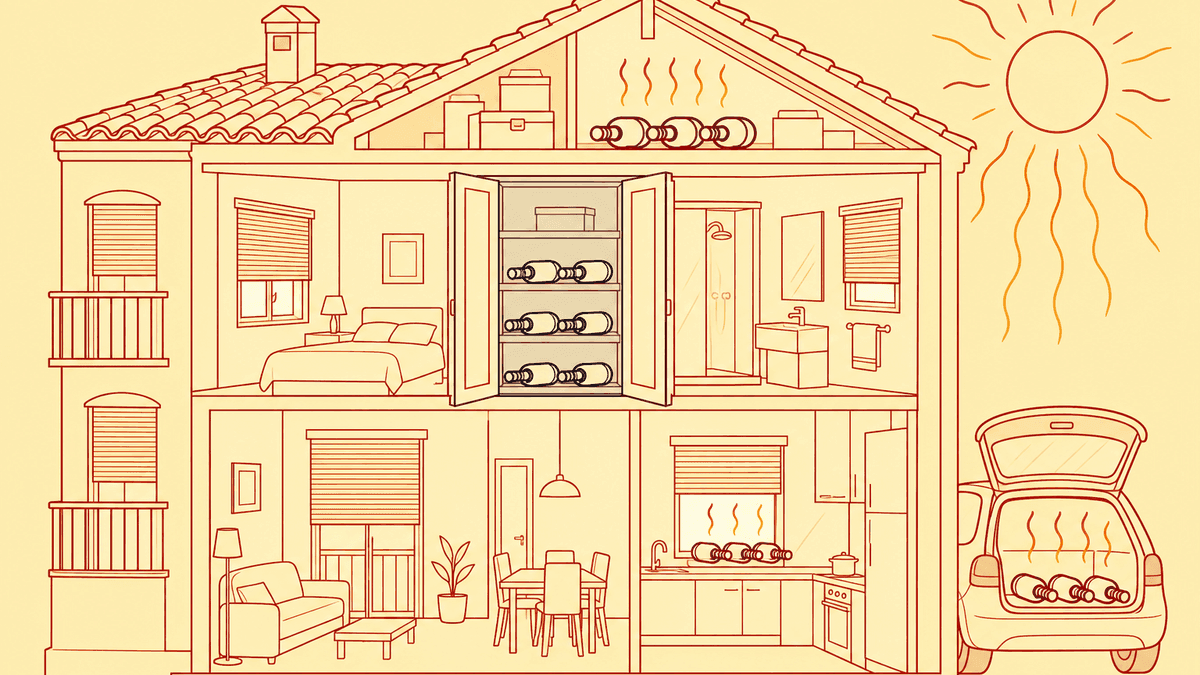 Not all rooms are equal in a heatwave: the coolest interior cupboard beats the kitchen, the attic, and never, ever the car.
A room-by-room audit
Walk your home and rank the options honestly. The best spot for most people is an interior wardrobe or built-in cupboard against a shared internal wall, away from windows and appliances. These spaces barely register the outside temperature and stay dark, which handles the light problem at the same time. A ground-floor or north-facing room usually beats an upper floor.
The kitchen feels convenient and is one of the worst choices, sitting beside the oven, the hob and the warmth thrown off by the fridge's motor. The everyday kitchen fridge is no rescue either; it runs too cold, too dry and too vibration-heavy for anything beyond a few days, as covered in our piece on why the kitchen fridge is the worst place to age wine. Attics and garages are the classic traps: they hit the highest peaks and the widest daily swings. And the car boot is simply the killer. A car parked in summer sun turns into an oven within minutes, and a few hours there will cook a case beyond saving. If you buy wine on a hot day, take it straight indoors rather than leaving it "just for a bit" in the car.
WineNest records where every bottle actually lives, so when you shift your good bottles into the coolest cupboard for July and August you still know exactly what is where and can find it again in September. No more discovering a forgotten case behind the winter coats after the damage is done.
When a wine fridge earns its cost
If your coolest room still drifts past the mid-20s for weeks on end, or you are holding bottles you genuinely intend to keep for years, a temperature-controlled wine fridge stops being a luxury. It holds a steady low temperature, kills the day-night swing, keeps light out and adds a little humidity so corks do not dry. For a modest everyday collection drunk within a year or two, a good dark interior cupboard is usually enough. For anything you are ageing deliberately, the fridge pays for itself the first summer it prevents a ruined case. Our guide to wine storage conditions at home walks through the trade-offs in more detail.
How to tell if a bottle got cooked
Heat damage often hides until you open the bottle, but there are tells. A cork pushed slightly proud of the rim, or one that resists then pops with unusual force, points to pressure from thermal expansion. Sticky residue or a stained capsule around the neck means wine has seeped past the cork, and where wine escapes, air gets in. In the glass, a heat-damaged wine tends to taste flat, cooked or oddly jammy and stewed, with the fresh fruit and lift stripped out. Physical signs do not always mean the wine is ruined, and a sound-looking bottle can still be tired, so trust your nose and palate on the first pour.
The kindest thing you can do for a collection is simply move it before the heat arrives and keep track of where it went. Log each bottle's location and drinking window as you go, and the summer relocation becomes a two-minute job rather than a guessing game come autumn. Plan your July shuffle now, and your wine will thank you in September. Download WineNest and use its bottle location log to map your collection before the next heatwave hits.