
Rueda Verdejo Beyond the Supermarket Shelf: A Guide to Spain's Biggest White
Why supermarket Rueda Verdejo tastes identical, and where the serious side lives: pre-phylloxera vines, Gran Vino de Rueda rules and six bottles to try.

Rueda Verdejo is the white wine Spain actually drinks. It outsells every other white in the country, and if you have ever ordered "un blanco" in a Madrid bar, there is a decent chance it was Verdejo from this stretch of high plateau south of Valladolid. Yet most drinkers only ever meet its supermarket face: cold, citric, interchangeable. Behind that wall of six-euro bottles sits one of Europe's most underrated serious white regions, complete with ungrafted vines older than phylloxera and a legal category built to prove it.
Why supermarket Verdejo all tastes the same
The uniformity is not an accident. It is a recipe, and Rueda executes it at scale.
Grapes for entry-level Verdejo are picked by machine at night, when plateau temperatures drop sharply and the fruit comes in cool and unoxidised. The juice is inoculated with selected yeasts and fermented cold, at around 13 °C, in stainless steel. Fermenting that cold preserves a specific band of aromas: grapefruit, fennel, freshly cut grass. The wine is filtered, bottled within months and released the spring after harvest. SevenFifty Daily describes this modern template bluntly: high yields, machine harvesting, cultured yeasts, cold fermentation and heavy filtration, all aimed at the international market.
It works. The Consejo Regulador's director general, Santiago Mora, told The Drinks Business that Rueda remains Spain's number one white wine D.O. by sales, and roughly nine of every ten bottles from the region are Verdejo. The recipe delivers exactly what a supermarket buyer wants: a reliable, zesty white at a fixed price point, identical vintage after vintage.
The problem is not that these wines are bad. Chilled hard on a July terrace, they do the job. The problem is a ceiling. Cold-fermented, early-released Verdejo shows the yeast and the temperature more than the place, which is why a 6 € bottle from one giant co-operative tastes so much like a 6 € bottle from another. Everything that makes Rueda genuinely interesting was stripped out on purpose: the old vines, the poor soils, the lees, the time.
The old vines under the pebbles
Rueda sits at 700 to 800 metres on the northern Castilian plateau, with brutal continental swings between day and night. Its best soils are known as cantos rodados: beds of smooth, rounded river pebbles over sand and gravel, sitting on clay-limestone. The stones drain fast, reflect heat onto the bunches and force the vines to dig deep.
Sand matters for a second reason. The phylloxera louse that destroyed Europe's vineyards in the late nineteenth century struggles to move through sandy soils, so pockets of Rueda and neighbouring Segovia still hold ungrafted, pre-phylloxera Verdejo growing on its own roots. Ossian, in the pine forests around Nieva at the Segovian edge of the region, farms parcels between one hundred and two hundred years old, organically certified, and ferments them with native yeasts in French oak. Barco del Corneta works gnarled goblet-trained vines around La Seca and Alcazarén, including a single pre-phylloxera plot of just 0.8 hectares at 750 metres.
Old-vine Verdejo from these sites is a different grape in the glass. The grassy pungency recedes; in its place come fennel seed, bitter almond, beeswax and a saline, stony finish with real grip. It is closer in spirit to serious white Burgundy than to anything on the supermarket shelf.
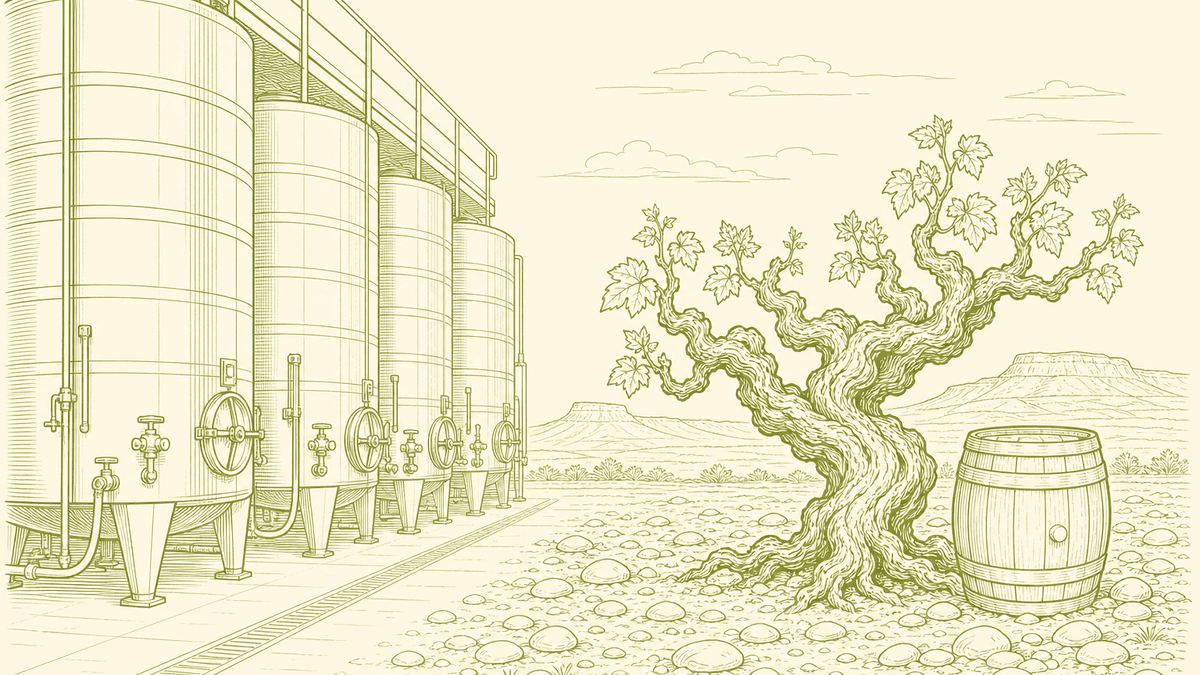 Two Ruedas: the tank-made summer white, and old-vine Verdejo rooted in cantos rodados.
Gran Vino de Rueda: the top end gets a rulebook
The region knows it has an image problem, and in 2020 it did something about it. The Gran Vino de Rueda category, approved in 2019 and launched from the 2020 releases, sets hard requirements: vines at least 30 years old, yields capped at 6,500 kg per hectare, a maximum juice extraction of 65%, and a minimum of one year's ageing (in bottle, barrel, tank, concrete or clay, the vessel is the winemaker's choice) before release. The same reform also created village wines, Vinos de Pueblo, for bottlings from a single named municipality.
Thirty-year-old vines and 6,500 kg/ha are the opposite of the supermarket recipe, where young, irrigated vineyards are pushed far harder. The extraction cap means only the gentlest pressing makes the cut. And the mandatory year of ageing forces exactly the thing early-release Verdejo avoids: time. If you spot "Gran Vino de Rueda" on a label, you are holding the region's own definition of its serious side. Our guide to reading a Spanish wine label covers where these mentions sit among the rest of the fine print.
Six producers worth your money
A short ladder, from weeknight to special occasion. Prices are rough current retail in Spain.
José Pariente Verdejo (around 12 €). The benchmark step up from the supermarket: estate fruit, more concentration, a proper fennel-and-citrus core. The family also makes a Fermentado en Barrica from old vines, fermented in 500-litre French oak and kept ten months on its lees with bâtonnage.
Javier Sanz V Malcorta (around 19 €). From Verdejo Malcorta, a nearly extinct clone the La Seca grower spent years recovering. It ripens later and holds more natural acidity than standard Verdejo, and the name means "hard to cut", after its tough wood. Singular, tense, worth hunting.
Menade (10 to 25 €). The Sanz siblings farm organically in La Seca and were among the first in the zone to bottle certified organic Verdejo. Their entry wine layers three separate picks of the same fruit; the old-vine cuvées ferment wild.
Barco del Corneta (around 25 €). Beatriz Herranz's low-intervention project: organic farming, old goblet vines, long lees ageing, no varietal make-up. Verdejo with the volume turned down and the detail turned up.
Ossian (around 30 €). The pre-phylloxera specialist mentioned above. Barrel-fermented but never oaky, creamy yet fresh, and one of the few Verdejos with a documented track record past ten years.
Belondrade y Lurton (around 40 €). Didier Belondrade's Burgundian take, made since 1994: spontaneous fermentation in French oak, nine months on lees. The 2024, bottled in July 2025 after a further rest before release, took 96 points from Tim Atkin. This is the bottle that first convinced critics Rueda could age.
Verdejo or Sauvignon Blanc? Rueda grows both
Marqués de Riscal brought Sauvignon Blanc to Rueda in the 1970s, and the D.O. still permits it, both solo and in blends. On paper the two grapes overlap: green aromatics, sharp acidity, best served cold. In the glass, Rueda's continental heat pushes Sauvignon towards passion fruit and boxwood, loud and front-loaded, while Verdejo keeps a firmer mid-palate, that signature bitter-almond twist on the finish, and far more to gain from lees and old vines. Sauvignon from Rueda is nearly always a drink-youngest wine; nobody is making a Gran Vino ambition out of it. If crisp Atlantic whites are more your line, our looks at Albariño's top Rías Baixas producers and the Godello grape map the alternatives.
Which Verdejos age, and which to drink this summer
The dividing line is simple: steel-and-release wines are for now; lees, barrel and old vines buy time.
Drink the entry-level, cold-fermented style within a year or two of the vintage, while the grapefruit and cut grass are loud. There is no reward for waiting; those aromas fade and nothing replaces them.
The serious tier runs on a different clock. Barrel-fermented and long-lees Verdejos (Belondrade, Ossian, José Pariente Fermentado en Barrica, Barco del Corneta) routinely improve for five years and beyond, trading green fruit for honey, toasted hazelnut and a waxy, saline depth. Ossian's own fifteen-year retrospective tasting showed the top wines still alive well past a decade. Gran Vino de Rueda bottlings are built for this arc by law. If you are new to thinking about wine on a timeline, start with our beginner's guide to drinking windows.
This is where a cellar tracker earns its keep. WineNest gives every wine you save a per-vintage drinking window, so your 2022 Belondrade shows as still climbing while the 2024 supermarket Verdejo flags itself as a drink-this-summer bottle. No more discovering a faded white two years too late.
FAQ
Is Rueda Verdejo the same as Verdejo? Not quite. Verdejo is the grape; Rueda is its home D.O. in Castilla y León. Verdejo is planted elsewhere in Spain, but Rueda holds the old vines and nearly all the ambitious versions.
What does Gran Vino de Rueda mean on a label? Vines over 30 years old, yields under 6,500 kg/ha, gentle pressing and at least a year's ageing before release. It has marked the region's official top tier since 2020.
Should I decant an aged Verdejo? Rarely necessary, but ten minutes of air helps barrel-fermented versions unfold. Serve the serious ones at 10 to 12 °C rather than fridge-cold, or you will mute exactly what you paid for.
Rueda rewards drinkers who look past the chiller aisle: same grape, same pebbly plateau, wildly different ambition. When you do bring a few of the serious bottles home, log them as you buy and let per-vintage drinking windows tell you which to open over ice-cold summer lunches and which to leave sleeping until 2030. Download WineNest and give your best whites the patience they were made for.